|
Thomas Hill’s
Proportional Representation Election for Schoolboys c. 1820
(An extract from "Your
vote - effective or wasted?" ISBN 0 9598728 2 5
© Proportional Representation Society of Australia 1980)
The form
of the Single Transferable Vote in multi-member
electorates that is now known in Australia
as the quota-preferential method of proportional representation was
first suggested in about 1820 by Thomas Wright Hill,
a Birmingham
schoolmaster. Thomas Hill
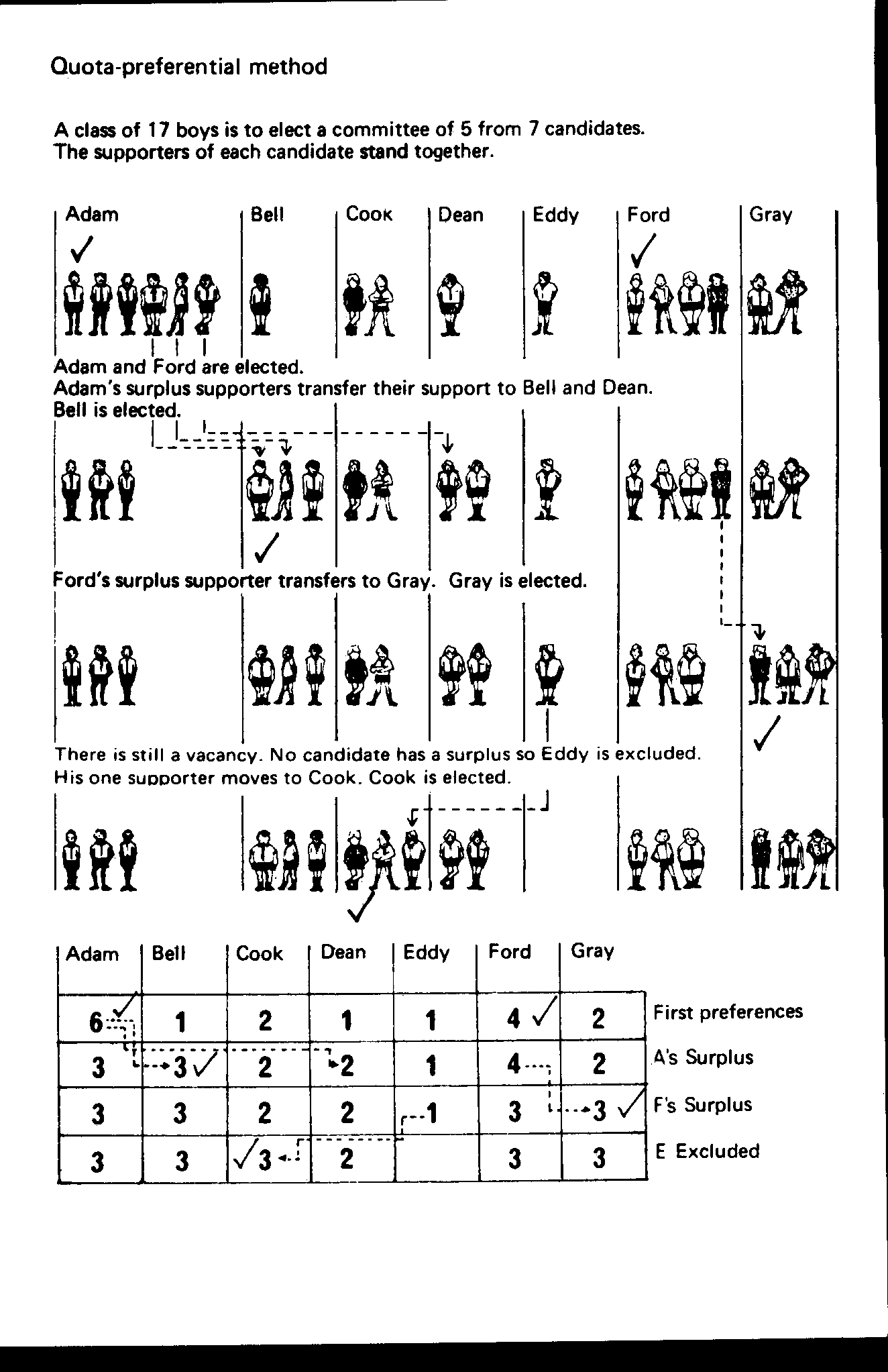
encouraged the boys in his school to use his method to elect a committee.
Although there is no detailed account of this election, it could have been
somewhat as in the diagrams below.
His son
Rowland, knighted after his major reform of the UK
postal system, had earlier been the Secretary of the Colonization Commission
of South Australia, in which position he is understood to have been
instrumental in the adoption of a quota system of proportional representation
for the first election of councillors for the City of
Adelaide, in
1840. That was the first quota PR election for public offices in the world,
and also the first election for public offices in Australia. A large oil
portrait of Rowland Hill hung
in Ayers House, Adelaide, the residence of a former Premier
of South Australia, after whom Ayers Rock was named. A direct descendant of Thomas Hill, Dr David Hill, is a member
of the Electoral Reform Society of the UK. He is
also a member of the Royal Statistical Society, and his work in support of
its use of quota-preferential PR for its elections appears on its website.
With 17 boys voting to appoint a committee of 5 from 7 candidates, we can
imagine the schoolmaster pointing out that any candidate supported by three
or more boys should be elected. Not more than five could each have three or
more supporters and this means that anyone with 3 or more supporters must be
among the 5 finally elected. This number of votes necessary for election is
known as the 'quota'. At the end of the
election, 15 of the boys are grouped into 5 quotas and there are 2 boys left
over. In fact, one of these is one who had originally supported the first
candidate elected. The result then is that 15 of the 17 boys see their first
preference candidates elected and only one is disappointed.
|
|
To print the
graphic below at the right size to fill an A4 page, click on it with your right hand mouse button and save the file,
tom_hill.gif, to your hard drive. Then open it and print it.
|
|
In this case, every boy could see how the others voted. It
was shown later by Thomas Hare in England and Carl Andrae in Denmark that the
same method could be used with secret voting. Voters can show by preference
markings on ballot papers which candidates they support and where they would
transfer their support is it was not needed by their first-preference
candidates. Instead of the boys grouping themselves in support of candidates
and eventually arranging themselves in quotas, the ballot papers would be
examined and the counting carried out as shown above.
Each stage of counting corresponds exactly to one stage in the schoolboys'
election.
Each voter had a wide choice of candidates and bodies of opinion are
represented by spokesment in numbers proportional to the numbers supporting
them, since each candidate elected is supported by a quota of voters.
This method has been developed for use in elections of all sizes, and several
refinements have been introduced to make it as accurate and effective as
possible. For example in transferring Adam's surplus, it is not necessary to
make and arbitrary selection of 3 of the ballot papers showing Adam as first
preference. It is better to examine all of them and to find which candidates
the voters have shown as second preferences. The surplus of 3 will be carried
by the 6 papers so each is given a 'transfer value' of ½. Each of the
unelected candidates is then credted with the papers showing him as second
preference, each with a value of ½.
The method can be used to fill any number of vacancies. In each instance, the
quota is calculated so that it is possible to form a number of quotas equal
to the number of vacancies but no more than this. It is found by dividing the
number of formal votes by the next whole number above the number of
vacancies, and taking the next whole number above the result of the division.
For example, in an election with 40,000 votes to fill 7 vacancies, the result
of dividing 40,000 by 8 is 5,000 and the quota is 5,001. If 7 candidates each
have 5,001 votes, totalling 35,007, there are only 4,993 votes remaining. So
only 7 quotas of 5,001 can be formed and this is the smallest number that
gives this result. It can be left to the voters to decide how many
preferences they wish to indicate. There is no need to compel them to
indicate preferences for all candidates.
|